Grouped circuit monitoring is a powerful capability within Panel Guard. Unlike many other energy management solutions, smart panels can be used to reduce a load calculation without CTs if installing CTs is impractical. Note that whole-home monitoring using CTs will result in a lower load calculation and fewer situations where Panel Guard needs to disable a circuit.
The infographic below displays Grouped Circuit Monitoring on a Lumin Smart Panel. The monitoring works the same way for a ReliaHome Smart Panel.
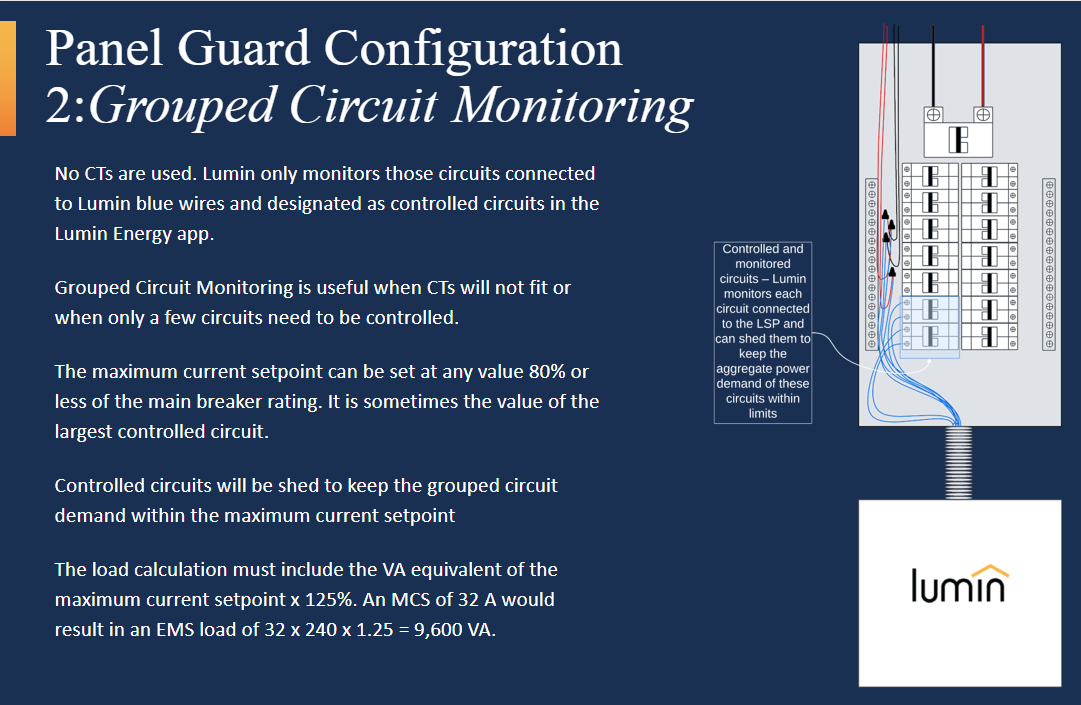
When configuring Panel Guard, choosing a Maximum Current Setting (MCS) for Grouped Circuit Monitoring is more complex than Whole-Home Monitoring.
Step 1: Determine the lowest possible value for the MCS:
Determine the nameplate amperage of the largest load controlled by Panel Guard (do not use the breaker rating as this may be too large/conservative). Add two amperes to this value. This is the low end of the MCS range.
Note: If the nameplate value is not available, you can determine the effective running amperage of a device connected to the smart panel by operating the device, observing the wattage in the Lumin app or ReliaHome Smart Panel app, and dividing the wattage by the nominal voltage (either 120 or 240 V). If using this method, be sure that you are using the device in its most power-hungry mode. For example, a dryer with multiple drying modes should be run in its highest heat mode.
Nameplate Example:
Controlled Circuits
| Appliance | Full Load Amps (Nameplate) |
| Dryer | 26 |
| Water Heater | 22 |
| Pool Pump | 24 |
The dryer is the highest nameplate rating at 26 amperes. Add 2 A to this figure. 28 A is the smallest recommended Minimum Current Setting for this Grouped Circuit Monitoring configuration.
Step 2: Determine the highest possible value for the MCS: First, perform a standard-method calculation on all the loads not under smart panel control. Once this value is determined, subtract it from the main breaker rating and multiply the difference by 80%. Largest possible Maximum Current Setpoint = 0.8(main breaker rating - calculated uncontrolled load).
Step 3: Choose a value in between the smallest and largest Maximum Current Setpoint. A larger MCS may allow multiple controlled devices to run continuously. A smaller MCS allows additional uncontrolled load.
Was this article helpful?
That’s Great!
Thank you for your feedback
Sorry! We couldn't be helpful
Thank you for your feedback
Feedback sent
We appreciate your effort and will try to fix the article